Industry Guides 8 min read
How Hotels Can Get More Direct Bookings Through Their Website
A practical guide to hotel website UX, room information, trust signals, booking paths, local search, and measuring direct enquiries.
By DevArea Editorial Team · Updated 5 July 2026
Quick answer
Hotels can make their website more useful for direct bookings by showing accurate room details and total-price information early, making availability search and booking steps mobile-friendly, explaining policies clearly, using real photography, and answering questions guests need before paying. A faster website alone will not guarantee direct bookings; rates, distribution, reputation, destination demand, cancellation terms, and the booking experience all influence the decision.
Start with the questions guests need answered
Guests compare practical details as well as photographs: room type and occupancy, bed configuration, amenities, meal options, check-in and check-out times, cancellation conditions, taxes and fees, parking, accessibility, location, and how to contact the property. Make these details easy to find before asking a guest to commit to a booking flow.
Use accurate, current room photography and label images honestly. If the picture shows a particular room type, say so; do not imply every room has the same view, layout, or amenity when it does not. Clearly explain when photographs are representative rather than of the exact room allocated.
- Room descriptions that match the inventory actually sold.
- Clear occupancy rules, bed type, amenities, meal plan, and accessibility information.
- Transparent taxes, mandatory fees, deposits, cancellation terms, and payment conditions before confirmation.
- Correct address, transport guidance, check-in policies, and a working phone/contact route.
- Trust information such as genuine reviews, verified policies, and secure booking/payment steps.
Make the direct booking path shorter and more reassuring
A visitor should be able to check dates, compare appropriate room types, understand the total price, and proceed without unnecessary steps. Keep forms short, support common mobile keyboards, explain errors in plain language, and do not clear entered information when a recoverable error occurs. Test the complete path including confirmation emails, availability updates, cancellations, and what staff see in the property system.
If the hotel uses a booking engine from another provider, measure the journey across the transition. The booking engine should visually and verbally match the property’s website, use a clear domain or trusted provider handoff, and communicate whether the booking is complete. Broken availability, unexpected fees, or inconsistent room names undermine the value of driving more visitors to the site.
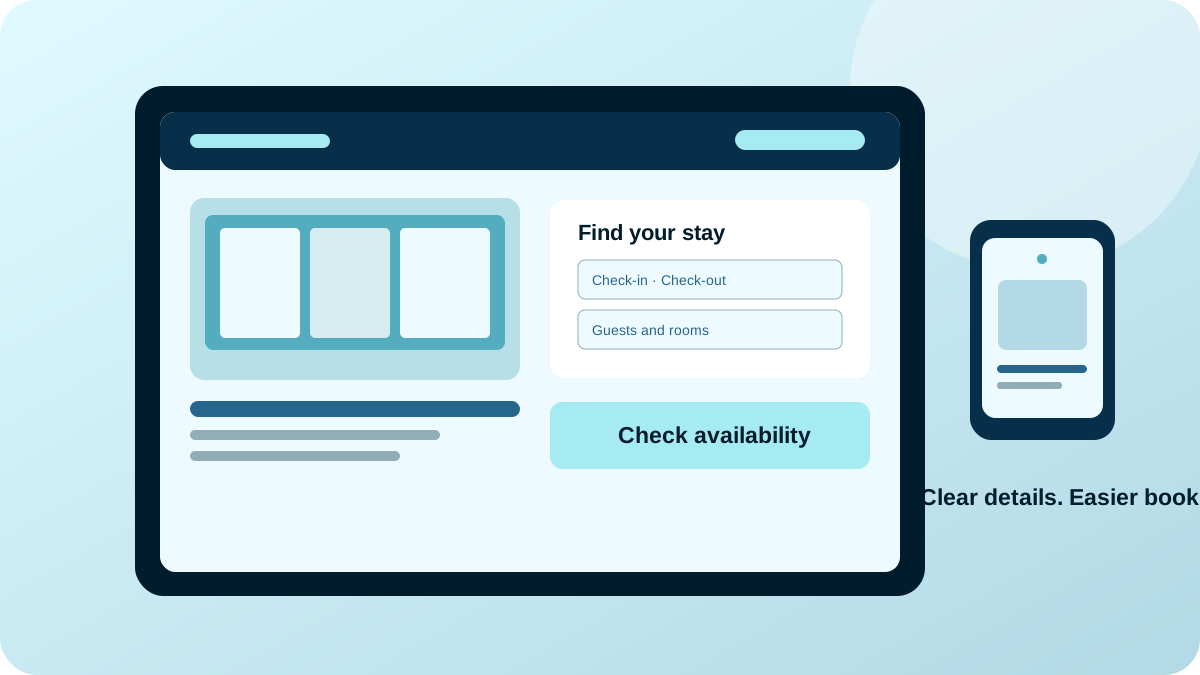
- Put a clear “Check availability” action where it is easy to find on mobile and desktop.
- Let guests choose dates and occupancy before showing relevant room options.
- Display the total or a clear price breakdown and cancellation terms before final confirmation.
- Provide secure payment handling and a clear booking confirmation with support details.
- Test the experience regularly on different screen sizes and real dates, not just a demo booking.
Give guests a genuine reason to book direct
A direct-booking message should explain a real advantage, not simply tell visitors that booking direct is better. Depending on what the property can consistently deliver, that may be a flexible package, direct access to staff for special requests, a bundled meal or experience, clearer policy options, or the ability to discuss a longer stay. Do not advertise an advantage that disappears in the final checkout or conflicts with distribution agreements.
Avoid claiming the lowest rate unless you can substantiate and maintain the promise under the stated conditions. Compare like with like: same dates, room, occupancy, meal plan, cancellation conditions, taxes, and currency. A guest values confidence and clarity as well as price.
Use local and destination content to help guests plan
A hotel website can help guests who search for accommodation near a landmark, business district, transport hub, hospital, university, event venue, or travel route. Build genuinely useful pages for the location and guest needs you can support: directions, travel times with appropriate caveats, nearby attractions, event logistics, parking, accessibility, and frequently requested stay information.
Do not mass-produce thin pages such as “hotel near [hundreds of landmarks]” with only the place name changed. Explain real proximity and transport options accurately, keep address data consistent, and update seasonal or operational details. Local content should help someone plan their stay even if they do not book immediately.
- A unique hotel title and description with property name and real destination context.
- Dedicated, useful pages for actual room types, facilities, events, or guest questions where warranted.
- Descriptive image alt text for meaningful room, amenity, and location images; decorative images should not repeat nearby text.
- Internal links between rooms, amenities, policies, location information, and booking actions.
- Accurate local business/hotel structured data aligned with content visible on the page.
Measure direct-booking performance—not just traffic
A traffic increase is not the same as a booking increase. Track the steps a guest takes: availability searches, room selection, begin-checkout events, completed bookings, call enquiries, and abandonment. Where a booking engine sits on a separate domain, configure analytics carefully and respect consent and privacy requirements. Avoid collecting payment details or sensitive personal information in analytics events.
Review the numbers by device, landing page, traffic source, travel dates, and room type where the data is reliable and lawfully collected. If many users search dates but few view rooms, availability or page clarity may be a problem. If users begin checkout and abandon it, inspect total-price visibility, payment options, form errors, and policy concerns before spending more on traffic.
A 30-day hotel website improvement plan
- Week 1: audit room names, images, inclusions, total-price presentation, and policy consistency across the site and booking engine.
- Week 2: test the mobile booking journey with several realistic date/occupancy combinations and fix the highest-friction issues.
- Week 3: improve the most visited room, location, and policy pages; add useful internal links and descriptive metadata.
- Week 4: verify event tracking and compare search, room-view, checkout, booking, call, and enquiry metrics to establish a baseline for ongoing tests.
Direct bookings are an operating outcome, not a promise a web agency can guarantee. Rates, inventory, reputation, demand, policies, and service delivery matter alongside design and technical quality.
Frequently asked questions
Does a hotel website guarantee more direct bookings?
No. A website gives guests a direct route and can reduce friction, but bookings also depend on market demand, rate competitiveness, reviews, inventory, location, policies, and the guest experience.
Should a small hotel show prices on its website?
When rates and availability can be kept accurate, transparent price information helps guests compare options and understand what is included. If rates are date-dependent, provide an availability/quote flow and explain mandatory taxes, fees, and conditions before confirmation.
What is the most important feature on a hotel website?
A reliable mobile-friendly availability and booking journey, supported by accurate room information, transparent pricing and policies, genuine photos, and visible contact details.
Can SEO reduce a hotel’s reliance on booking platforms?
Useful destination and property pages can attract some search demand directly, but results vary and take ongoing work. Hotels should treat direct, referral, paid, and third-party channels as a portfolio rather than assume one channel will replace all others.
Sources and further reading
- Google Search Central: SEO Starter Guide
Official fundamentals for descriptive titles, useful content, crawlable links, and images.
- Google Search Central: Helpful, reliable, people-first content
Guidance on original information and helpful content written for visitors.
- Google Search Central: Local business structured data
Official information on valid local business data and rich-result eligibility.
- W3C WAI: Forms concepts
Accessibility guidance for labels, instructions, validation, and form usability.
This article is general educational guidance. Pricing and implementation needs vary by business; verify official platform guidance before making technical or compliance decisions.
Need help applying this to your website?
DevArea works with businesses in Lucknow and supports projects across Uttar Pradesh, including Ayodhya and Gonda. Share the scope and goals for a practical next step.